What kind of Themes are emerging from signals of change impacting the innovation landscape mid-year 2025?
In my previous posts, I highlighted how More-than-human as a main theme for 2025+ is linked to an ongoing discussion around defining intelligence. Seven out of the nine defined planetary boundaries, which are critical for maintaining a stable and habitable Earth, have been crossed. So, we need to widen the lens to find new solutions.
I categorised More-than-human Intelligence into four types: BIOLOGICAL, COLLECTIVE, EMOTIONAL and ARTIFICIAL Intelligence. Using these categories as a lens, we can find rich opportunity areas for innovations. Next, I wrote about Cultural Shifts in the categories and what new narratives are emerging.
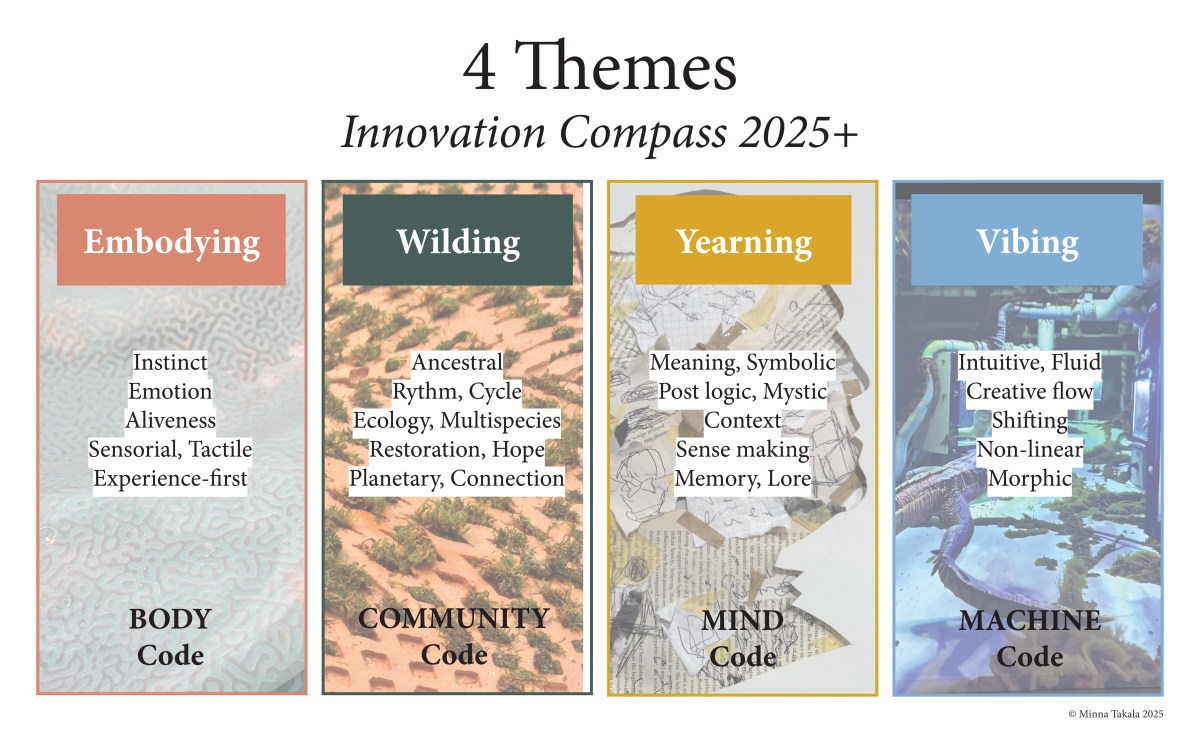
Now, let’s look more closely at what type of themes are emerging mid-year 2025 to guide Strategy Directions and Formulations. Themes bring together elements and issues around a topic as one unifying idea. Themes are never about one thing, so they can be used to close the gap between strategy and creativity, blurring the lines between design, communication, culture and behaviour changes. Themes give context and a wider picture to the ongoing discussions.
1. Embodying
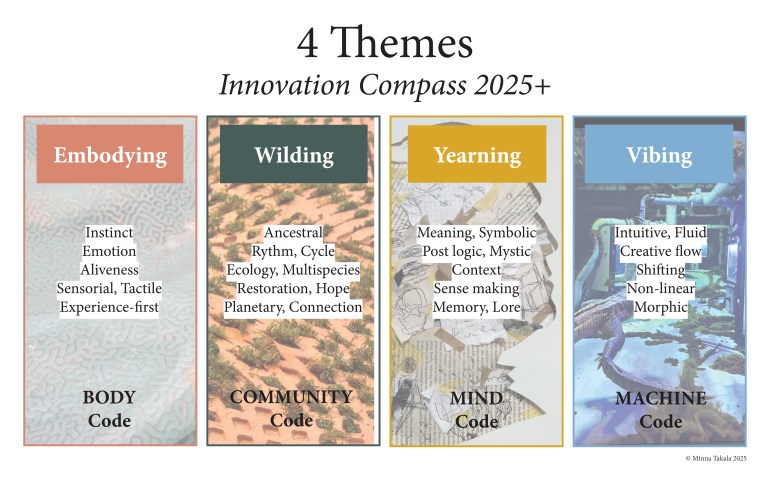
Starting from the BIOLOGICAL lens for intelligence, Embodying is the first Strategy direction.
The theme of Embodying asserts that cognition, consciousness, and experience are fundamentally inseparable from the body and its sensorimotor capacities, as well as its active interactions with the physical and social environment.
It pushes back against the notion that intelligence is solely a computational process or that the brain functions in isolation from the rest of the organism.
VISUAL & CULTURAL ANALYSIS
MAPPING REVEALS NEW DIRECTIONS
Design research across categories like Art & Culture, Retail & Interiors, and Stories & Communication reveals emerging signals of visual language and cultural cues for new directions.
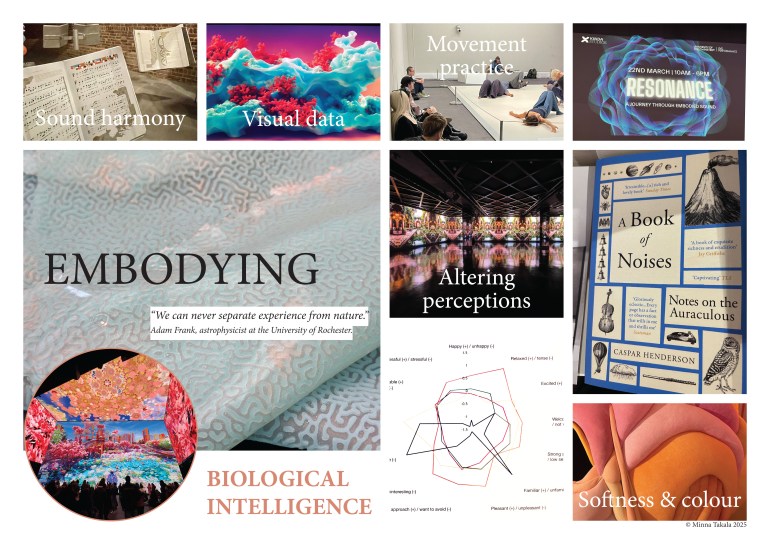
When EMBODYING we
- Prioritise active, integrated user experience, where the interaction deeply engages the user’s sensory and motor skills, making the experience performed rather than passively received.
- Foster a sense of co-creation, acknowledging that users shape and are shaped by the products and environments they interact with, much like organisms and their life-worlds.
- Are designed with an awareness of the holistic integration of mind, body, and environment.
- Aim to build solutions that resonate with the aliveness and deepest connections of human experience.
CONTEXT ANALYSIS
Contextual analysis reveals new meanings of behaviour changes that explain how Embodying is changing our orientation.
Impact of Embodying for Innovation
Innovation is moving beyond purely technical or functional advances to focus on human and biological flourishing:
- Holistic User Experience Design: multisensory integration and full-body engagement.
- Co-Creative and Participatory Systems: processes will shift to collaborative co-creation with users and communities.
- ‘Alive’ and Responsive Technologies: to integrate principles of autopoiesis (self-organising) and enaction from biological intelligence.
- Innovation in Human-AI Symbiosis: relationships where AI augments and extends human capabilities.
- Qualitative and Experiential Metrics: measuring and understanding subjective, qualitative experiences.
2. Wilding
Next, using a COLLECTIVE lens for intelligence, Wilding is the second Strategy direction.
Wilding, as an extension of collective intelligence, conceptualises design as a dynamic, interconnected process that goes beyond human-centric thinking. It embraces the principles of more-than-human design, which considers the intricate interactions and interdependencies between humans and a vast array of nonhuman entities, including animals, plants, water, bacteria, sensors, and data.
VISUAL & CULTURAL ANALYSIS
MAPPING REVEALS NEW DIRECTIONS
Design research across categories like Art & Culture, Retail & Interiors, and Stories & Communication reveals emerging signals of visual language and cultural cues for new directions.

WILDING is
- Moving beyond mere functionality to mend fractured relationships with nature and culture.
- Includes deeply ingrained, often non-verbal, physical, and historical forms of knowing.
- Democratises resources and finds profound narratives in the overlooked.
- Resistance and Dismantling Power Structures through actively decolonising and de-patriarchalising.
- Process as Community and Embodied Relationship are as vital as the outcome.
Contextual analysis reveals new meanings of behaviour changes that explain how Wilding is changing orientation.
Impact of Wilding for Innovation
- Expanded Sources of Intelligence: transforms nature from a mere resource into an active co-designer and source of inspiration.
- Holistic Problem-Solving: fosters systems thinking, leading to more comprehensive and interconnected solutions.
- Material and Methodological Breakthroughs: adds layers of meaning and function beyond the purely aesthetic or utilitarian.
- Contextual and Culturally Sensitive: leads to solutions that are deeply rooted and relevant to specific communities and environments.
- Process-Oriented: emphasis shifts from delivering a finished product to fostering an ongoing process of making and unmaking.
3. Yearning
Next, using an EMOTIONAL lens for intelligence, Yearning is the third Strategy direction.
Yearning as a creative concept for design innovation signifies an emotional intelligence that recognises and addresses deep, often shared, desires for connection to past (even imagined) realities or to lost future ideals. It’s about designing for a longing that transcends simple recollection, tapping into collective dreams, unfulfilled potentials, and a nuanced appreciation of temporal shifts.
VISUAL & CULTURAL ANALYSIS
MAPPING REVEALS NEW DIRECTIONS
Design research across categories like Art & Culture, Retail & Interiors, and Stories & Communication reveals emerging signals of visual language and cultural cues for new directions.
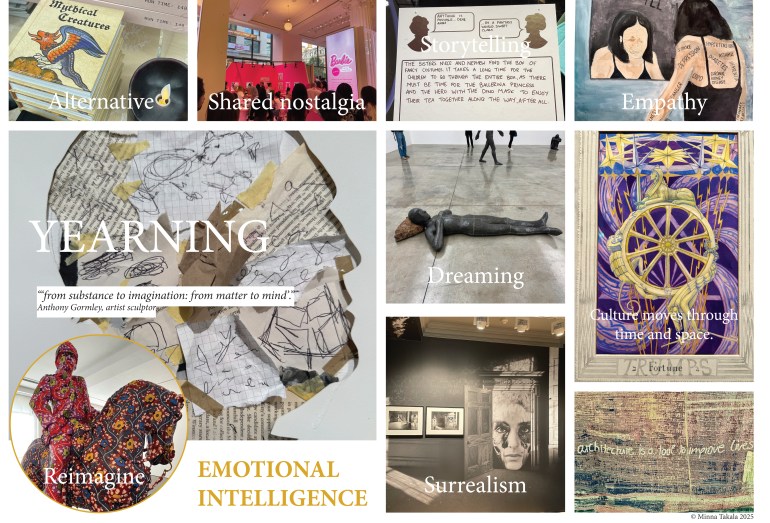
Yearning for
- Emotional literacy and agency in navigating complex inner landscapes.
- More compassionate and socially responsible systems.
- Exploring the cultural roles of fantastical and symbolic, mythical creatures.
- Historical reckoning, justice, and a re-imagined collective identity.
- Existential and Philosophical deeper understanding of human existence.
Contextual analysis reveals new meanings of behaviour changes that explain how Yearning is changing orientation.
Impact of Yearning for Innovation
- Translating the Abstract into the Experiential: physical, sensory engagement with complex emotional narratives.
- Fostering Empathy through Direct Engagement: direct, embodied learning (or witnessing).
- Driving Authenticity and Vulnerability: access and express deep, often challenging, yearnings to create more resonant and impactful solutions.
- Creating Vehicles for Cultural Migration: for scalable and adaptable innovation.
4. Vibing
Finally, using an ARTIFICIAL lens for intelligence, Vibing is the fourth Strategy direction.
With AI levelling the technical playing field, taste becomes the most invaluable asset. According to music producer Rick Rubin, practising Vibing means cultivating the ability to know what good feels like and having the discerning vision to guide AI-generated output, ensuring designs resonate authentically and carry a distinct “soul in the signal.” This encourages designers to be honest with their vision, iterate relentlessly, and embrace their personal, subversive creativity — their weirdness — as a unique edge against algorithmic homogeneity and a way to create a distinct signal in a sea of noise.
VISUAL & CULTURAL ANALYSIS
MAPPING REVEALS NEW DIRECTIONS
Design research across categories like Art & Culture, Retail & Interiors, and Stories & Communication reveals emerging signals of visual language and cultural cues for new directions.
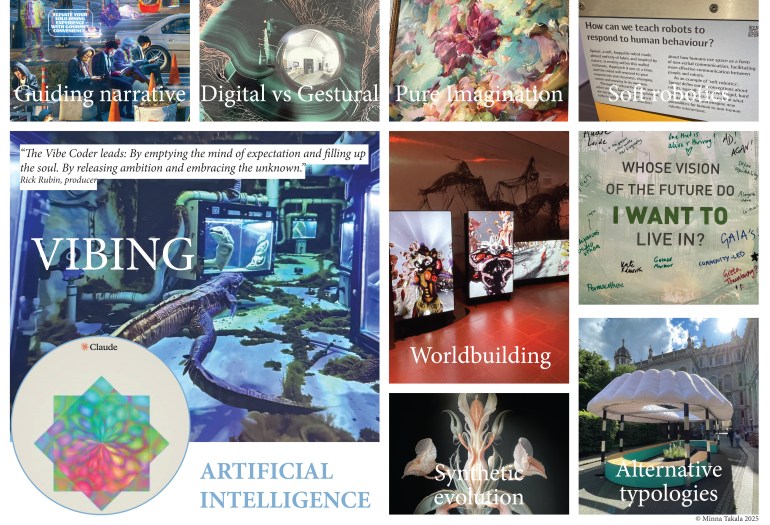
Vibing is a fundamental shift in human-technology interaction that is emerging, moving from a master-tool dynamic to one of augmentation, co-creation, and intuitive partnership. This changes how we define creativity, authorship, and even intelligence. It is also fostering a decentralisation of expertise and power, where taste and vision become paramount over technical virtuosity.
Contextual analysis reveals new meanings of behaviour changes that explain how Vibing is changing orientation.
Impact of Vibing for Innovation
- Human-AI Symbiosis: innovations where AI is not just a computational engine but an intuitive design partner.
- Taste as the New Currency: shifts the focus from how to build to what to build and why.
- Interdisciplinary Blurring: breaking down traditional disciplinary silos, fusing art, science, technology, philosophy, and social practice.
- Decentralised and Community-Driven Innovation: DAOs and community-led projects enabling more equitable and inclusive innovation ecosystems.
- Focus on Experiential and Intangible Value: unique experiences, emotional resonance, and consciousness-raising over purely functional or material benefits.
- Adaptive and Evolving Systems: creating adaptable, plug-in systems and products that can evolve and be reconfigured.
- Ethical and Ecologically Conscious Design: solutions that aim for socio-ecological equity and rewilding of both nature and human spirit.
CONCLUSION
In the future, we will see innovations that are more fluid, intuitive, culturally resonant, and ethically self-aware. They will be less about rigid control and more about guiding emergent qualities, embracing the weirdness of human creativity, and leveraging AI to ask and respond to better questions about what truly matters.
Recommendations for Radical Creativity
What if we stopped designing for users and started co-evolving with them?
What if innovation wasn’t about solving problems, but about asking better, deeper questions?
What if intelligence wasn’t measured by outputs, but by how well we listen to bodies, ecosystems, emotions, and machines?
What might emerge if we dared to create from the edges, from the weird, the wild, and the yearning?
These themes aren’t just speculative, they’re strategic invitations to rethink what innovation can mean now.
 Trending Topics by Minna Takala