
During the LFA (London Festival of Architecture), I joined a group walking tour exploring the dramatically changing neighbourhood of South London. We used a psychogeography tool to sense spatial boundaries and reflect on how we experienced each place.
Why visit this neighbourhood?
Elephant and Castle’s £4 billion regeneration has been one of London’s largest and most transformative urban projects. While it has introduced high-rise developments, it has also triggered gentrification, displaced affordable housing, and caused widespread concern. The area’s social fabric has shifted significantly with the loss of community spaces and local businesses. In many ways, it has become unrecognisable.
MAPPING THE TERRITORY
The walk was organised by Social Life, a research organisation exploring how people are affected by changes in the built environment. This was a follow-up to their original ethnographic study in 2019 in the area. By revisiting the same location, the aim was to deepen understanding of how change unfolds over time.
We perceive cities through our senses. By identifying boundaries between neighbourhoods, we can track shifts in our sensory experience. Put simply, do we feel good or bad here? What is the importance, large or small? What about energy, fast or slow? By examining these transitions, we gain insight into how urban environments impact us on a sensory and emotional level. This kind of mapping helps us design places that feel better to be in.
Repeated studies like this uncover the layers of history and collective memory that shape local identity. They help us better understand the essence of a place.


Method
The approach was based on the Sensory Notation Toolkit. The method developed by Social Life comes from Colin Ellard’s work (a psychology and neuroscience Professor at the University of Waterloo, in Canada). It encourages researchers to become attuned to how particular environments stimulate their senses.
The goal of the walk was to collectively map sensory experiences and reflect on the emotional impact of ongoing change. At each stop along the route, we rated sensory stimulation (visual, aural, kinetic, thermal, and chemical) on a scale from 1 to 5.


The route was designed to create stark contrasts between stops. This made clear the contrasts between positive and negative feeling environments. For example, the Strata Tower by Elephant and Castle roundabout was followed by a blooming community garden, which is located right at the foot of Strata Tower. Each shift offered a distinct emotional and physical experience.


Moving from the windy, noisy and hectic area to a calming and quiet natured community garden


From the towering corporate landscape to the new and clean ‘Low Line’ pedestrianised historical street, to the wide and sparse maisonettes and terraced houses
COLLECTIVE and EMOTIONAL INTELLIGENCE
In my previous posts about the theme More-than-human Intelligence and Cultural Shifts 2025+, I introduced More-than-human Intelligence categories: BIOLOGICAL, COLLECTIVE, EMOTIONAL and ARTIFICIAL Intelligence.
- Collective Intelligence refers to the combined knowledge and problem-solving abilities of groups.
- Emotional Intelligence involves managing personal emotions and understanding those of others.
Using both types of intelligence in planning helps reveal not just what people think, but how they feel. By using bipolar scales rather than binary choices, we gain a richer, more nuanced understanding of emotional responses. This approach can uncover subtle reactions that more traditional surveys may miss.
The focus is on capturing the connotative or affective meaning rather than agreement with a proposition. The method may capture a more authentic, nuanced, and less biased emotional or associative response, as it encourages respondents to consider the full spectrum of meaning rather than just reacting to a single proposition.
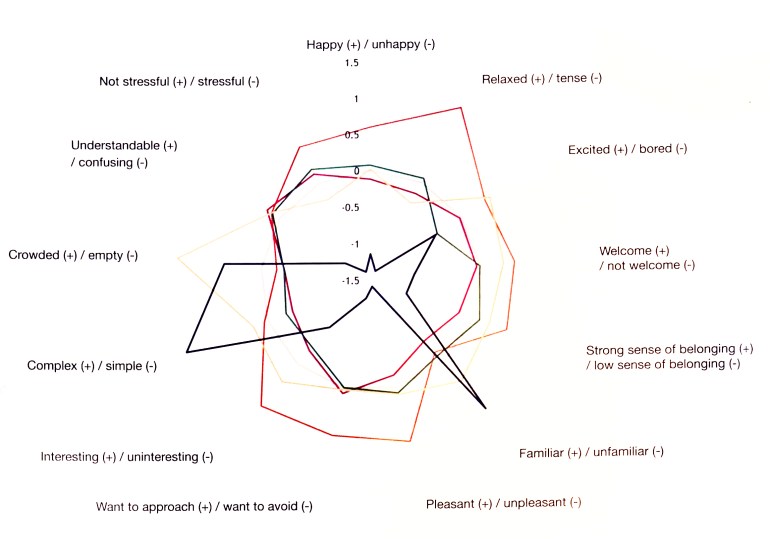
These emotional and collective layers offer a more holistic understanding of how planning decisions affect people’s lived experiences. They deepen our insights into the complex relationships between place, identity, and change.
What next?
What if we add the BIOLOGICAL and ARTIFICIAL INTELLIGENCES into the planning process?
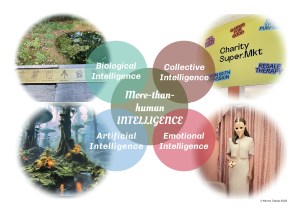
- Biological Intelligence invites us to learn from nature’s adaptability.
- How has urban nature evolved in this area? What ecological changes are happening, and what can we learn from them?
- Artificial Intelligence could offer new insights into community needs.
- What might an AI agent working for the local council suggest based on hyperlocal data and long-term trends?
 Trending Topics by Minna Takala