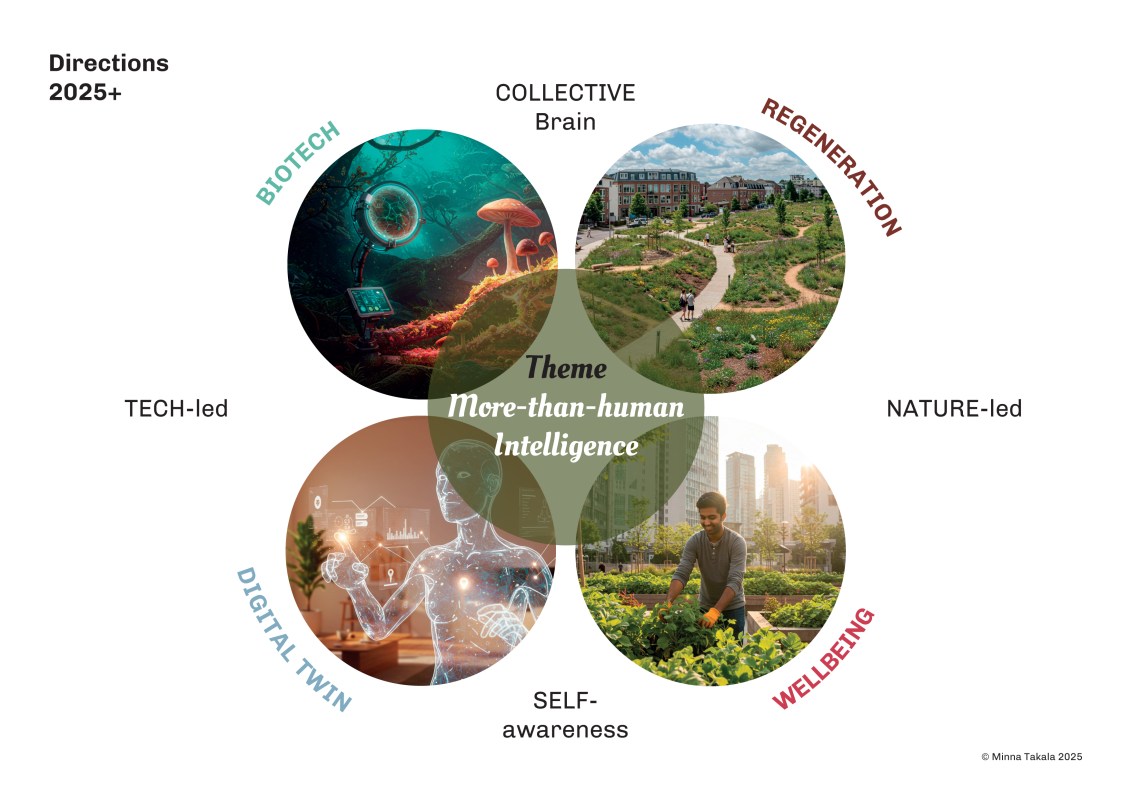
The theme for 2025+ is More-than-human Intelligence. It is about broadening the concept of intelligence outside humans to nature and non-living intelligence created by technology. These emerging fields offer innovation opportunities. How can the foresight process be used to explore the theme?
More-than-human Intelligence theme brings together natural and non-living intelligent fields beyond humans. There is a growing interest in understanding and using nature’s exceptional intelligence for resilience e.g. through biology, ecology and ancient traditions. On the other hand, artificial intelligence is advancing from taking over tasks from individuals to moving towards (system-level) operators.
Framework
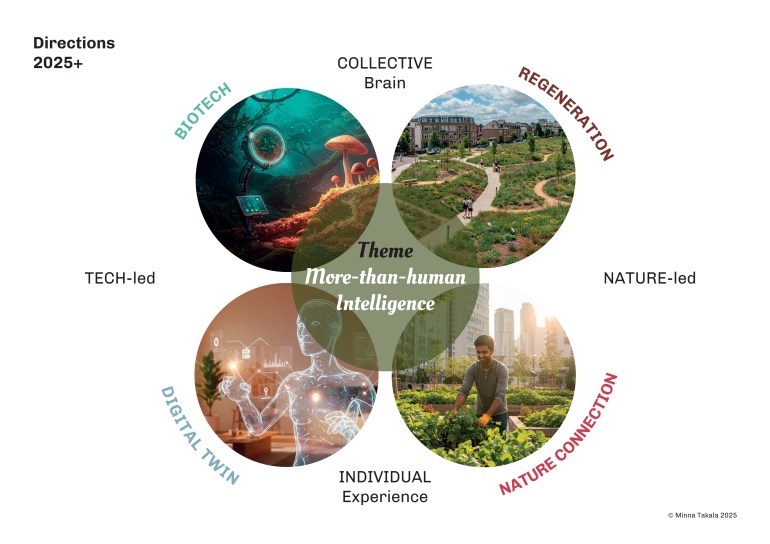
Where can we find new opportunities in these emerging fields? The framework below guides innovation using More-than-human Intelligence through a Collective and/or Individual lens. It presents how to use technology and/or nature-led thinking to create new solutions.
The image below reveals four cohorts emerging from the analysis: BIOTECH, REGENERATION, WELLBEING AND DIGITAL TWIN. How can four cohorts be used to find opportunities for innovation, ideation, and concept development?
FORESIGHT ANALYSIS
Using methods like STEEP (= Social, Technological, Economic, Environmental, Political) we can start by analysing how external factors influence trends and predict futures across categories. Three levels of change from macro and meso (social) to micro indicate trend impact and guide exploring opportunities.
SOCIAL Category
MACRO: Mental health crisis. Being in nature can improve mental health
MESO: Social media algorithms create mental fatigue, brain rotting
MICRO: Nostalgia, Community action and connection
TECH
MACRO: Artificial intelligence & Machine learning. System-level transformation of technology and biology.
MESO: Artificial alternatives to commercial products normally sourced from the wild.
MICRO: Personalisation using AI from LLM and Behavioural models to activate operational tasks for individuals.
ENVIRONMENTAL
MACRO: Climate emergency and Biodiversity loss
MESO: Repairing nature e.g. soil, interest towards nature’s wisdom and native traditions
MICRO: Seeing nature as a source for improving health and wellbeing
ECONOMIC
MACRO: Increasing costs of environmental damage like extreme weather
MESO: Digitalisation of rights, Blockchain and smart contracts provide more agency and democracy. Multi-actor economic models
MICRO: Sharing responsibility, low consumption/ underconsumption trending
POLITICAL
MACRO: Geopolitics
MESO: Digital authoritarianism. Culture wars
MICRO: Polarisation increases the dividing opinions between people
OPPORTUNITY MAPPING
Opportunity mapping is a tool to anticipate future possibilities. It deepens understanding of opportunity impact and dynamics. There are several ways to practice mapping techniques. Mapping explores language and trends in relation to power systems. It also reveals social order.
A simple way to use mapping is to start from the desired outcome and work backwards on how to get there. For example, More-than-human Intelligence as a desired outcome will create more nature positive outcomes.
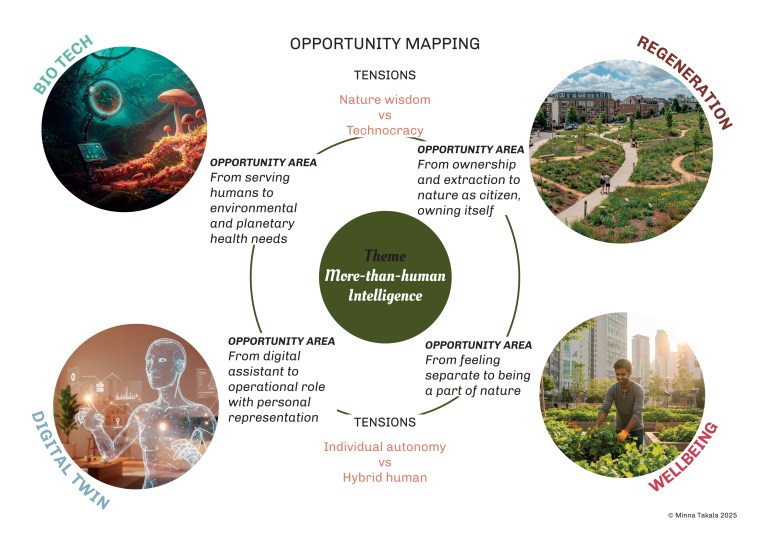
The image below presents opportunity areas for each cohort.
TENSIONS
To bring about significant changes in a system, it’s crucial to understand the existing power structures and the conflicts between them. In the context of More-than-human Intelligence, we need to find a balance between two opposing extremes for the system to work well.
Two Tensions that are Future Forces of Change:
Nature wisdom vs Technocracy
Individual autonomy vs Hybrid human
By seeking a balance between tensions, we uncover opportunity areas to solve challenges and progress toward the future. This process acts as a roadmap for innovation. The key lies in understanding the specific case, figuring out the right opportunity to address it, and determining the direction to take for a solution.
What if?
Next, we can start the ideation process using What if -questions to fuel imagination and creative thinking towards creating new solutions. Here are some speculations of how the future could unfold.
BIOTECH
More-than-human Intelligence created from the intersection of biology, ecology, and social design, has emerged as a transformative force.
- What if? Biotechnology embraces symbiotic relationships with nature
REGENERATION
More-than-human Intelligence is shaping the understanding and interactions with their natural environments creating more inclusive planetary communities.
- What if? experiences of humans & more-than-humans are central to urban planning and design
WELLBEING
More-than-human Intelligence can shift society towards valuing human-nature connection and community strength.
- What if? ‘Community Weavers’ strengthen bonds between humans & non-humans within neighbourhoods and towns
DIGITAL TWIN
More-than-human Intelligence creates a virtual representation of an individual, playing a crucial role in interaction with others and engaging with the world.
- What if? Digital Twin becomes central to personal identity and social interaction
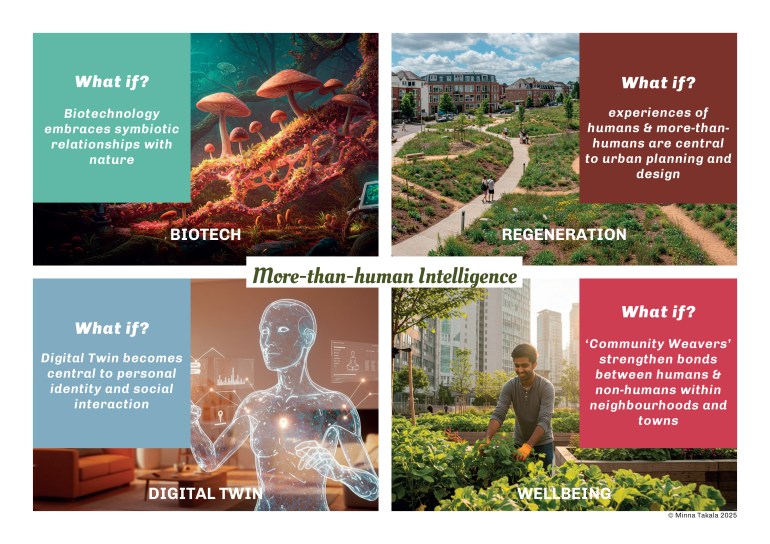
WhatIFpedia, an immersive experiment in AI-augmented future forecasting, brought to you by IFTF and Handshake was used in creating some of the What if -questions. Images were created by Google’s AI tool ImageFX
Next steps
After initial ideation, the process moves to work on the best ideas towards concepts and prototypes.
Alternatively, in policy design ideas will be developed considering policy impact e.g. could artificial intelligences that demonstrate self-awareness have legal personhood.
 Trending Topics by Minna Takala