As an independent design strategist, I always push thinking towards new methods and tools when collaborating with clients. Until recently using creativity, intuition and imagination has been mostly an add-on design method. However, attitudes have shifted since common methods have not produced enough new thinking to solve polycrisis and complexity problems.
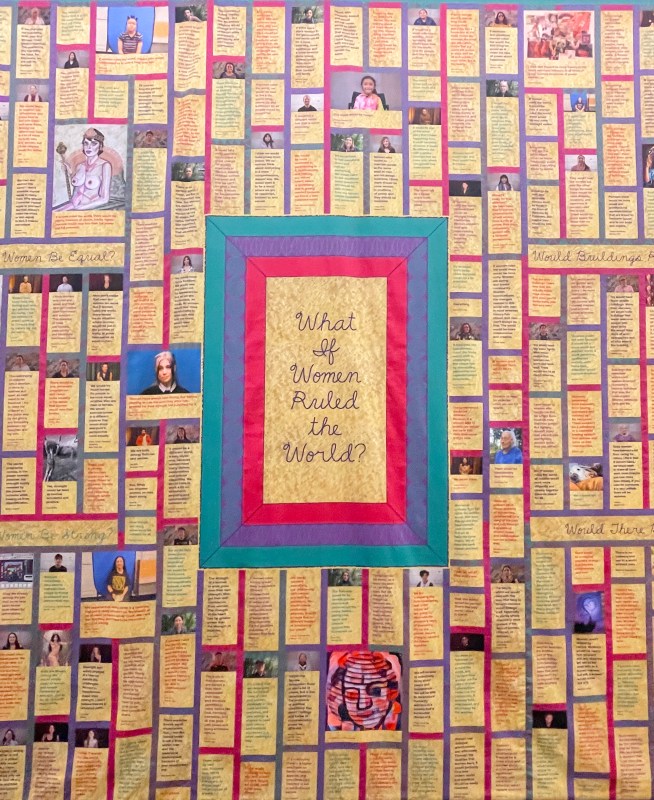
Image: Leading feminist artist Judy Chicago’s What If Women Ruled the World? Participatory Quilt is an ongoing collaborative project where individuals congregate, virtually and physically, to share their ideas about gender equality and imagine alternative worlds. Serpentine Gallery, London
Some years ago, the participatory research method that includes wider groups of stakeholders emerged as a way to understand complexity better. Now, collective imaging has gained popularity especially to push thinking in future visioning projects. It is a great way to unlock creativity and expand thinking beyond existing systems.
Power of Collective Imagining
Alternative thinking is gaining momentum since the climate and other polycrisis keep worsening. Even though system change has been recognised as a solution, progress has been slow.
Collective imagination is a more inclusive and engaging way to grow hope and positivity for the future. It enables new thinking to broaden views beyond existing systems by revealing limiting beliefs.
Collective imaging can also bring new voices of the collective into the forefront of discussions to decolonise existing dominating and oppressive systems. It builds the capacity to collaborate and work with others.


Artists have always imagined and created their versions of the world. Yinka Shonibare’s CBE, Decolonised Structures at the Serpentine Gallery, London is a great example of exploring power structures and constructions of cultural identity.
Tavares Strachan’s monument reimagines Leonardo’s Last Supper and is included in a major colonialism survey at the Royal Academy. The 12 Black figures in ‘Monument’ are from the 17th century to the present day with common histories of overcoming power structures designed to keep them oppressed.
Decolonising with New Memories
Systems are always based on power structures. Re-creating collective positive new memories of past traumatic events can be used as a powerful design approach to gain agency from systems of domination. Participating in collective imaging group work allows freedom to think differently and construct future and past memories through peer-to-peer learning.
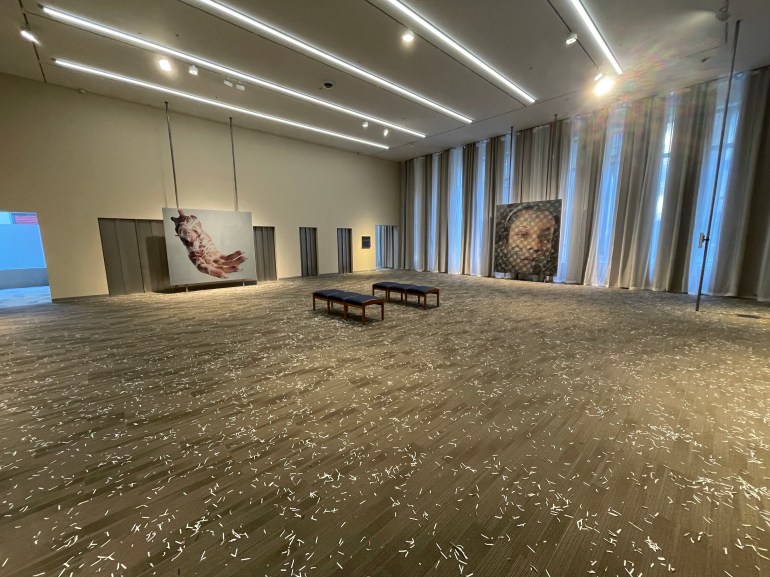
With the ‘Free Fall’ art installation American artist Avery Singer reflects upon her personal experience of the 9/11 terrorist attacks on the World Trade Center in New York City and explores the wider societal impact of collective trauma and proliferating image culture and media dissemination. Based entirely upon Singer’s childhood memories, the works and architectural intervention in the exhibition are a testament to the power of memory—and a memorial to a moment of terror and survival. Hauser & Wirth Gallery, London
Collective imaginations can be visualised to make alternative views more tangible using e.g. AI tools. They have even been used to manipulate childhood photographs to re-create memories and heal traumatic past events.
To take the idea even further a Digital Human Twin could mean outsourcing your memory to a Digital Assistant to manage daily life. What type of long-term consequences would that have for our memory?
Design Futuring Towards Transformation
Wider acceptance of the plurality of worldviews has increased in recent years together with the growing importance of non-linear thinking. There is more awareness now of how individual memories don’t stay unchanged but can evolve as we age. So, collective remembering of past events is perhaps more varied than previously thought.
This opens up new horizons into how to imagine future scenarios.
Futures cones have been used traditionally in exploring different scenarios and worldviews. Alternative Futures cone explores both: many futures and many pasts. This framework was developed by Dr. Josephine Chambers to imagine the future for transformation.

Source: ‘Around the future in eighty worlds’ article by Dr. Josephine Chambers, Assistant Professor at the Urban Futures Studio & Copernicus Institute of Sustainable Development
Inner Growth
Systems can only really change from the inside. Intrinsic values have been neglected in the conversations but are now emerging as part of the psychological and cultural aspects of systems change. There are more practises that build on awareness-based activities like collective imagining for example Body Mapping exercises.
CONCLUSIONS
Today, many government officials, corporations and individuals especially in the Global North still don’t feel responsible for polycrisis since they are separated from the consequences. Collective imagination opens minds to see how changes affect the whole system due to interdependence. (Butterfly effect)
Systems can only really change from the inside. Collective imagining can reveal limiting beliefs to change perceptions and construct new memories that decolonise power structures to start a transformation process.
 Trending Topics by Minna Takala