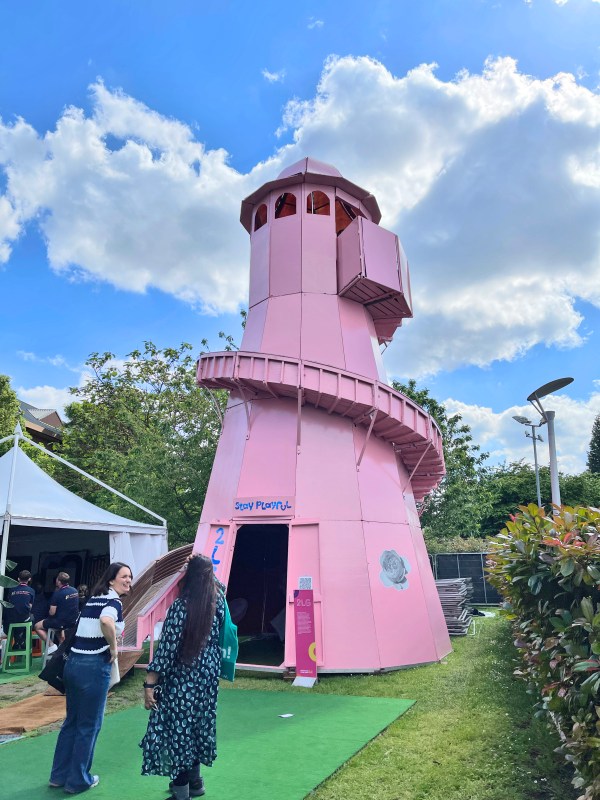
Clerkenwell Design Week is a great example of how local centralised design events are successful compared to a city-wide approach. The London Design Festival has been struggling in recent years losing the battle against Milan as the world’s design capital. In comparison, Clerkenwell has continued to rely on the strength of the locality of one area.
Image: Stay Playful (When No One Feels Like Playing) installation by 2LG
What Clerkenwell Design Week has always been very good at providing is a great visitor experience. This year there was a lot of talk about unreasonable long queuing at the Milan fair exhibition spaces. It seems obvious that the visitor experience should be the starting point for designing a design event.

Another important aspect of locality is a great atmosphere. Trade shows can be very busy and stressful. At the same time, they should be inspiring and uplifting, which Clerkenwell still manages to produce after many years. This year many showrooms were providing live music.
What about the design itself? New and radical? Increasingly not. However, that is not necessarily a bad thing. Hopefully, it means a shift away from speed and overconsumption using unsustainable practices. Design should be long-lasting.
Here are selected examples from cross-category research showing the main trend directions.
Colour stories
Overall, collections continue to expand into more untraditional colour choices. A soft pastel story is the most dominant one. Dusty pink is the most common choice, but baby blue is a new direction.
Pastels have a calming effect according to research. Traditionally, Clerkenwell has mostly provided workspace design solutions, but the boundaries are increasingly blurred between the home and the office space.


Neutral Nature colours are both safe and timeless choices. The climate crisis is forcing interior and manufacturing companies to apply more circular practices, which are taking place gradually. However, transparency is needed and knowledgeable customers are key to scrutinising these processes.
Another increasingly important aspect is wellbeing, which feeling close to nature, natural materials and colours can provide.


Retro is always a popular direction. This time it is the 70’s nostalgia that looks comes across in new designs.


What was new and emerging?
- Needs for larger bathrooms as wellbeing and relaxation spaces where increasingly new routines and rituals can enhance the mood and reduce stress levels.
- On the other hand, the trend towards maintaining compact spaces with clever storage and multi-use furniture is going to grow in the future.
- Since more people are living in rental properties easy assemble and non-permanent applications like the magnetic parquet solutions will be a win-win for all.


 Trending Topics by Minna Takala