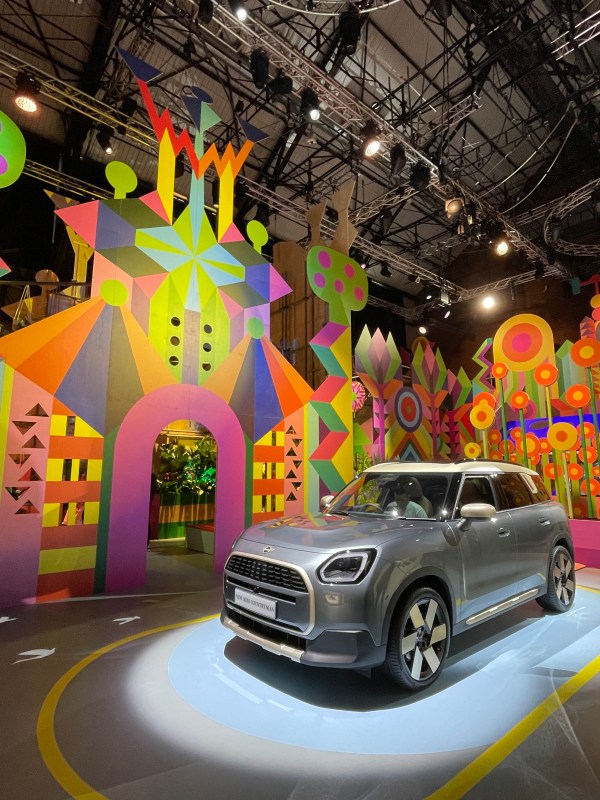
The London Design Festival has been running for 20 years. Last year I wrote about how it has evolved towards smaller local events, and this direction is continuing. The most noticeable change this year was the absence of big brands’ exhibition space. (What happened to the new exhibition centre in North Greenwich?) Looks like the ‘competition’ over Europe’s design capital between London and Milan is over. Due to Brexit, the Pandemic and the Cost of Living crisis Milan is now the undisputed leader in the field of design festivals.
Image: immersive installation by Morag Myerscough and MINI
Smaller and local
Two Design Fairs that took place this year were the Design Fair and Material Matters. They both have a distinct profile attracting mostly independent SMEs rather than big, well-established brands. (The Design Fair was smaller than before, missing the floor where bigger brands used to be). Material Matters focuses on circular economy and new sustainable materials development.
13 Design Districts across the city offered an ever-growing number of local exhibitions, events etc. The problem is that hardly any visitor will have an opportunity to go around these events that happen same time all over the city. The trend of localisation and decentralisation, however, continues to grow.
Products must tell a story
The Design Fair was crowded with exhibitors showing drastically individual styles. But how to stand out from this competition? It was nice to see that many exhibitors had learned to tell their individual story what makes them unique. The communication was accomplished in a variety of ways; sometimes in a larger context and special collaboration, sometimes with transparency of their process of making or simply with a short explanation of what the design is about.


Power of Curation
Material Matters fair was put together under one umbrella theme of New Sustainable Materials for Circular Economy. This approach creates clarity and has advantages. If you are interested in the topic, then as a visitor you won’t be disappointed. The fair covered a great variety of product exhibitors, installations, a marketplace, and a learning area and a talks programme. In addition, the fair works with the podcast to bring to wider attention, the people, companies and organisations around the topic.
Education is an important part of the Circular Economy. A great example of this was an informative installation by Pearson Lloyd called Material Change.
Circular design expands our responsibilities to consider material sources, supply chains, distribution models and the processes of reusing, repairing and recycling.
They presented core principles of design: design with data/ for circularity/ with new technologies/ with bio-based materials/ for self-assembly/ with mono-materials/ for repair/ on a longer timeframe


As a designer, I love the idea of making something out of nothing. A great example of this was a Tyre Wear Particles Capture Device by the Tyre Collective, whose mission is turning pollution into products. It was also great to see new product applications using this material like the Acoustic Panel containing 20% tyre particles and recycled PLA by LOWPOLY.


Collaborations and Installations
The London Design Festival is known for its large public installation commissions across the city. However, it is notoriously difficult to design successful large-scale urban installations. Most of the time they don’t work. Perhaps, it is time to use that budget in something else.
What can work well instead is a collaboration with an artist or design agency and a big brand. I saw two excellent examples of that. What made both great was the immersive and engaging aspect of the projects.
Nice to Meet You Again by Morag Myerscough and MINI
This immersive large-scale installation by artist Morag Myerscough was a truly immersive sensorial visceral mood-enhancing and uplifting experience. It brought awe and wonder with surprising elements like nature sounds and dramatic lighting. The large space provided also talks, hanging around, informative, and refreshment areas. The product launch and displays of new electric Mini cars were secondary to the art installation and didn’t fight for space and attention.


The LEGO® Piece Garden by The LEGO® Group and creative media brand It’s Nice That
LEGO® Piece Garden was a a brand collaboration offering an engaging and playful experience for visitors with a multi-layered program (workshop, socials, artist in residence etc.). The outcome of a playful making and imaginative experience using the LEGO Adults Welcome range and LEGO Botanicals Collection was to take part in building a community garden. All the used Lego bricks were re-used again and again during the event.


Future Directions
At the moment The London Design Festival is trying to find renewed identity. Perhaps the time for large-scale big brand fairs and events is over? So what is on the horizon? At least curation, unifying themes, and well-designed brand collaborations are already working well.
 Trending Topics by Minna Takala